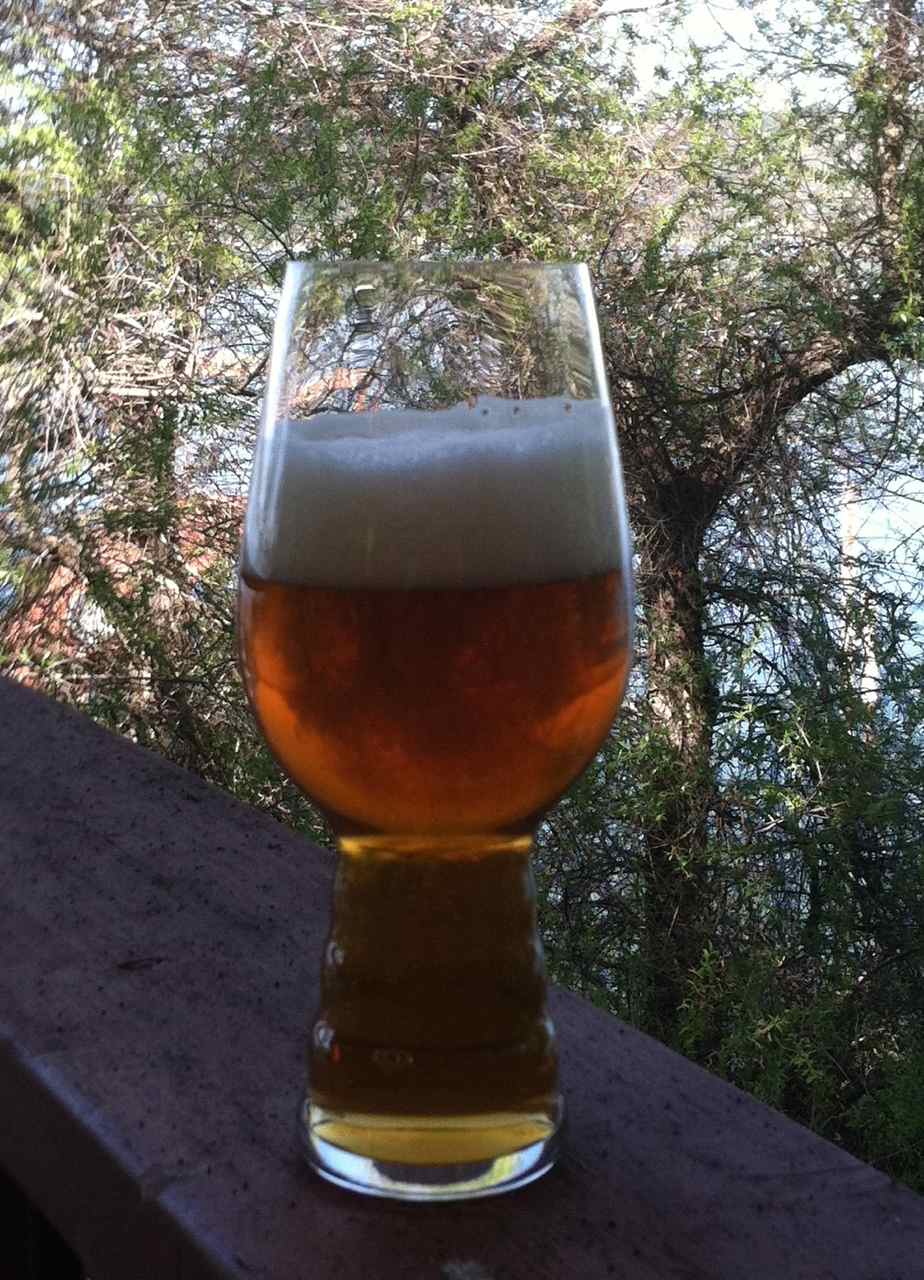
A few weeks ago I brewed a beer that I hoped would be a session IPA(1). On that front, I have good news and bad news. First, the bad news: Alas, at 5.2% ABV, it has turned out to be too high in alcohol (2). The good news? I got beer. And it’s not bad at all. I picked up the flavor of horehound in the non-carbonated beer.
It is now in the keg getting carbonated and had hops and grapefruit peel added for flavor and aroma.
I will try to brew a session IPA again as soon as we kick the keg of Grapefruit Pulpin.
Yes, there are lots of definitions of what a “session” beer is, and doubly so for what constitutes a session IPA. My working definition is something below 4.5% ABV.
It started too high in fermentable sugars and ended up too low in specific gravity.
I have become interested, nay, some would say obsessed, in that oxymoron of beers, the “session” IPA(1).
I like drinking a lower alcohol beer that isn’t like sex in a canoe, you know, “f**king close to water.” And you know the beers. The ones that taste slightly…umm…yellow. Besides being low in alcohol they are low in flavor and aroma. They are just a small step up from sparkling water, only with less taste.
The trend in microbreweries had been to brew bigger. Why make an IPA, when you can make a Double IPA? According to the American Homebrewers Association, Russian River’s Pliny the Elder is the best beer in America. I have had Pliny at Russian River Brewing. It tastes terrific but at 8.0% ABV, one pint is all I can drink. Driving is out of the question. Walking to Peet’s Coffee across the street and staring at my hands is all I can manage after a pint of Pliny.
So if you want to drink more than a thimble’s worth of tasty brew and be able to operate machinery, such as a lawnmower, you need something with less alcohol. To meet that need, some breweries have started making hoppy beers with lower alcohol. Examples include Squatters’ Full Suspension Pale Ale (4.0% ABV), Stone’s Go To IPA (4.5% ABV), and New Belgium’s Slow Ride Session IPA (4.5% ABV).
The best session IPA (perhaps the best session beer) around, in my opinion, is Ballast Point’s Even Keel. It packs a whole lot of flavor into a beer with 3.8% ABV (1). Ballast Point says Even Keel is “A full-flavored beer with a silky malt backbone and a bright hop profile of herbs and citrus, it packs all the taste of an IPA in a sessionable alcohol content.” It is just a damn good beer. RateBeer gives it a 92. Beer Advocate gives it an 86. Those are respectable scores for a beer with less alcohol than Bud Light.
Once I knew that a great session IPA could be made, I had to try my hand at making one.
Session IPAs are not regular IPAs with water added. The goal is to make a beer with all the taste, mouthfeel, and aroma as a big beer but with less alcohol.
Change the base. To keep that flavor and mouthfeel, cut down on the base malt but not the specialty grains, and consider using more flavorful malt such as Maris Otter or Vienna instead of pale malt. The goal is to reduce the fermentable sugars the malted grain produces during the mash process.
Cut back on the hops. Every beer has a BU:GU ratio, that is, bitterness units to gravity units. If you lower the gravity, you will need to lower the bitterness to keep the same perception of bitterness. As a professor of mine used to say, “It’s all relative.” For example, if your favorite IPA has a BU:GU ratio of one and it’s OG (original gravity) is 1.070 with 80 IBUs and you decide to lower your OG to 1.040 then your new IBU target should be 45 IBUs (40/70 x 80). The 45 IBUs will keep the same bitterness to maltiness as the bigger beer. Also consider hop bursting and and hop stands to give the flavor and aroma punch without the added bitterness that comes from boiling.
Consider poorer attenuating yeast (that is one that finishes at a higher specific gravity). Also, consider under-pitching the beer. You want to leave sweetness and maltiness in the background so the beer doesn’t taste watery. Instead of California Ale yeast try Ringwood or an English Ale yeast. You want the fruity ester compounds.
Smooth Sailing Session IPA
Recipe
Batch Size: 5.50 gal
Boil Size: 7.00 gal
Boil Time: 60 min
End of Boil Vol: 6 gal
Final Bottling Vol: 5.00 gal
Est Original Gravity: 1.044
Est Final Gravity: 1.014
Estimated Alcohol by Vol: 4.0 %
Bitterness: 36.4 IBUs
Est Color: 6.9 SRM
Efficiency: 70%
Grain Bill
2.174 kg Vienna Malt (Great Western) (3.5 SRM) 50.6 %
1.087 kg Pale Malt (2 Row) US (2.0 SRM) 25.3 %
0.353 kg Caramel/Crystal Malt – 20L (20.0 SRM) 8.2 %
0.353 kg Caravienne Malt (22.0 SRM) 8.2 %
0.163 kg White Wheat Malt (2.4 SRM) 3.8 %
0.163 kg White Wheat Malt (2.4 SRM) 3.8 %
Hop Schedule
9.00 g Galaxy [14.80 %] – First Wort 60.0 min
7.00 g Cascade [5.50 %] – Boil 20.0 min
7.00 g Chinook [13.00 %] – Boil 20.0 min
7.07 g Chinook [13.00 %] – Boil 5.0 min
7.00 g Cascade [5.50 %] – Boil 5.0 min
16.00 g Amarillo [9.20 %] – Steep/Whirlpool 0.0 min
8.00 g Chinook [13.00 %] – Steep/Whirlpool 0.0 min
16.00 g Simcoe [13.00 %] – Dry Hop
16.00 g Cascade [5.50 %] – Dry Hop
32.00 g Grapefruit peel – Dry Hop
Yeast
2.0 pkg American West Coast Ale Dry Yeast (Danstar #BRY-97)
Mash Steps
Name Description Step Temperature Step Time
Mash In Add 11.20 l of water at 168.2 F 156.0 F 15 min
Mash Out Add 4.48 l of water at 202.4 F 168.0 F 10 min
Boil for 60 minutes.
I will let you know how it turned out in a few weeks. In the meantime, have you brewed a session beer? How did it turn out?
According to the Beer Judge Certification Program, an American IPA is:
“A decidedly hoppy and bitter, moderately strong American pale ale, showcasing modern American or New World hop varieties. The balance is hop-forward, with a clean fermentation profile, dryish finish, and clean, supporting malt allowing a creative range of hop character to shine through.” pg 37, 2015 BJCP Guidelines (PDF)
For comparison, Bud Light, Miller Lite, and Coors Light each have 4.2% ABV.
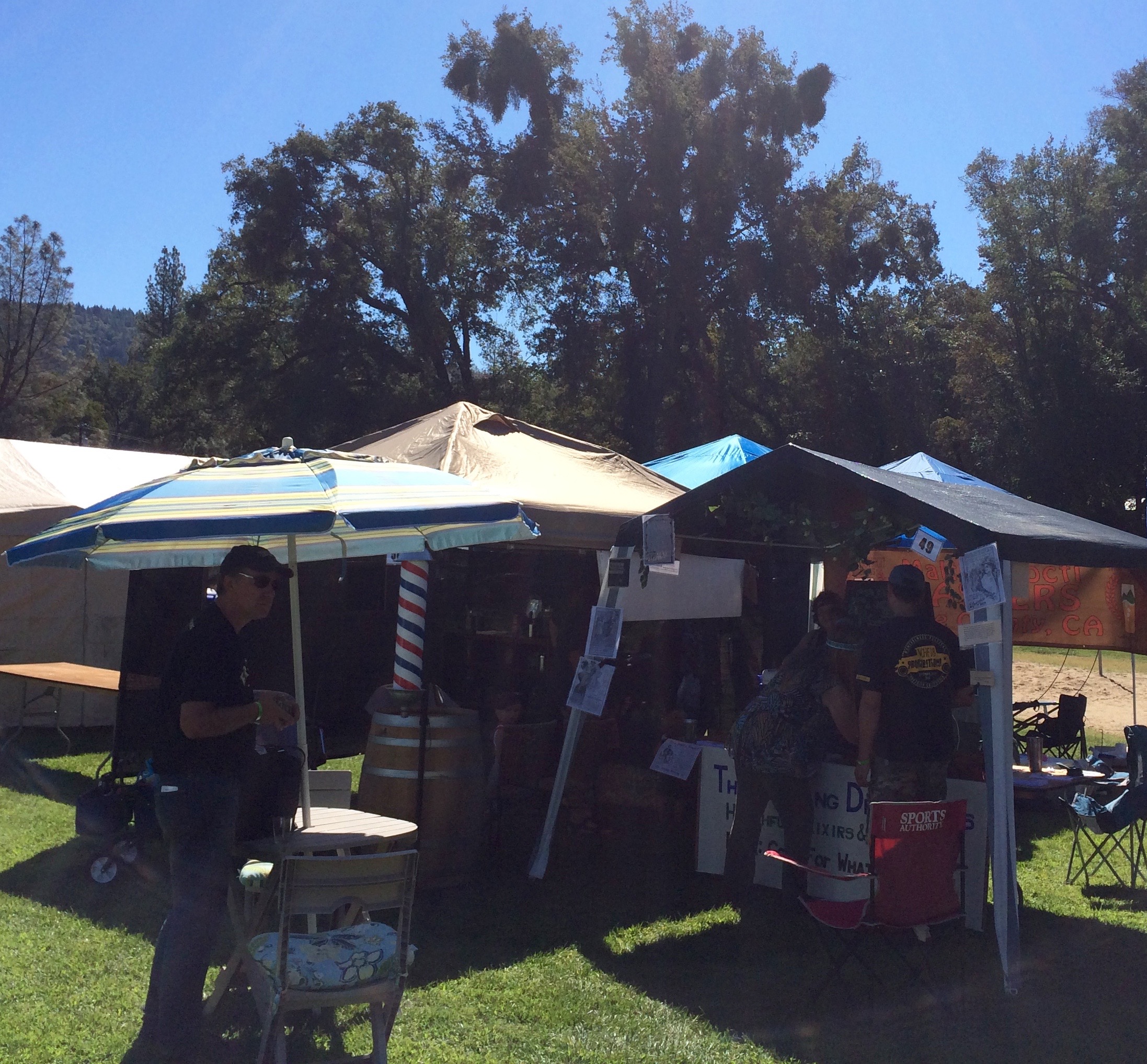
Our Malt Konocti Mashers’ booth on the right with a little waiting area in front of the dispensary.
This year’s theme was Prohibition. Under the 18th Amendment to the US Constitution, doctors could write prescriptions for alcohol. “You’ve gotta fever and the prescription is more beer.”
Looking toward “Home” (left of photo) where you register and buy tee-shirts.
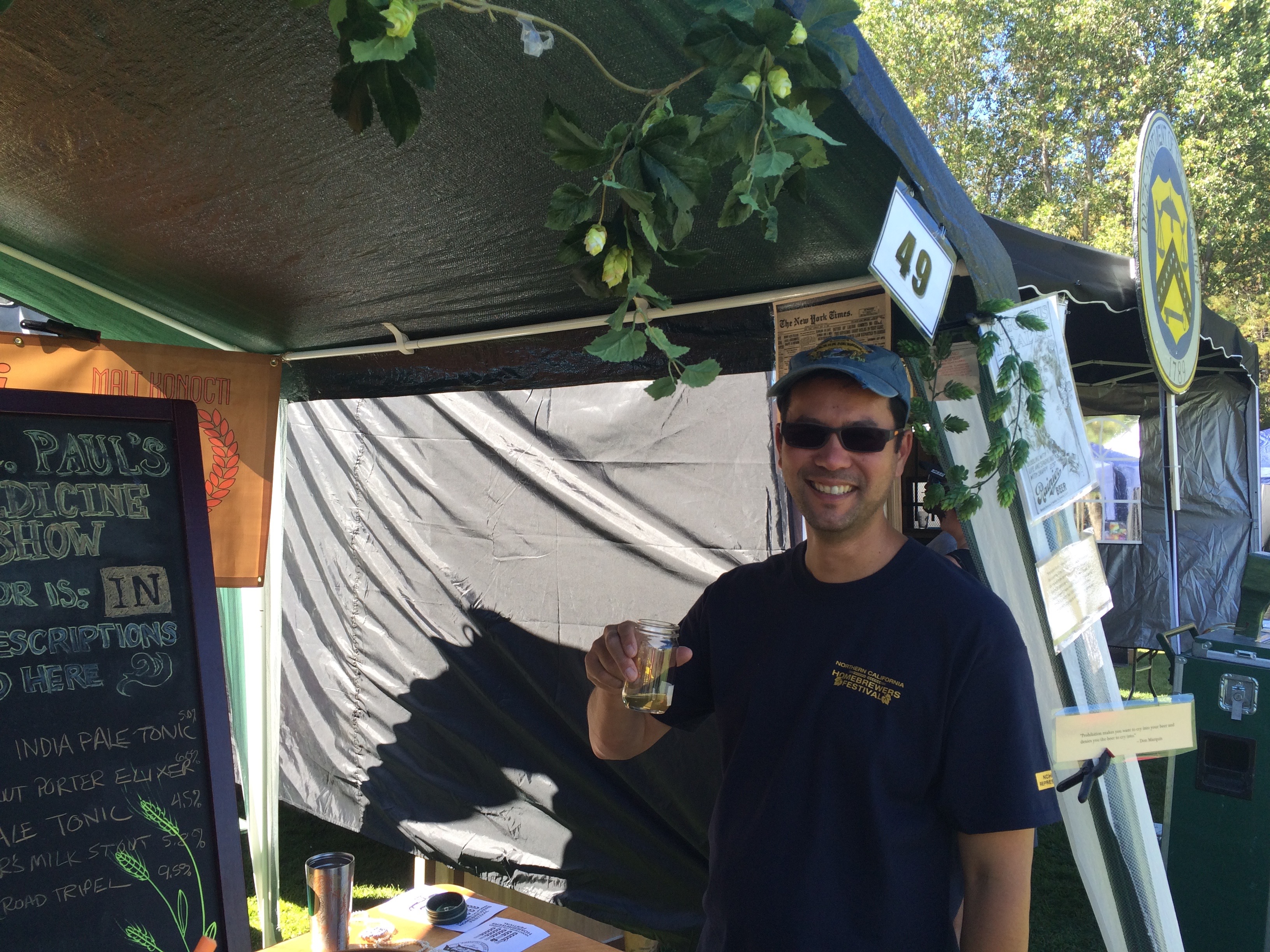
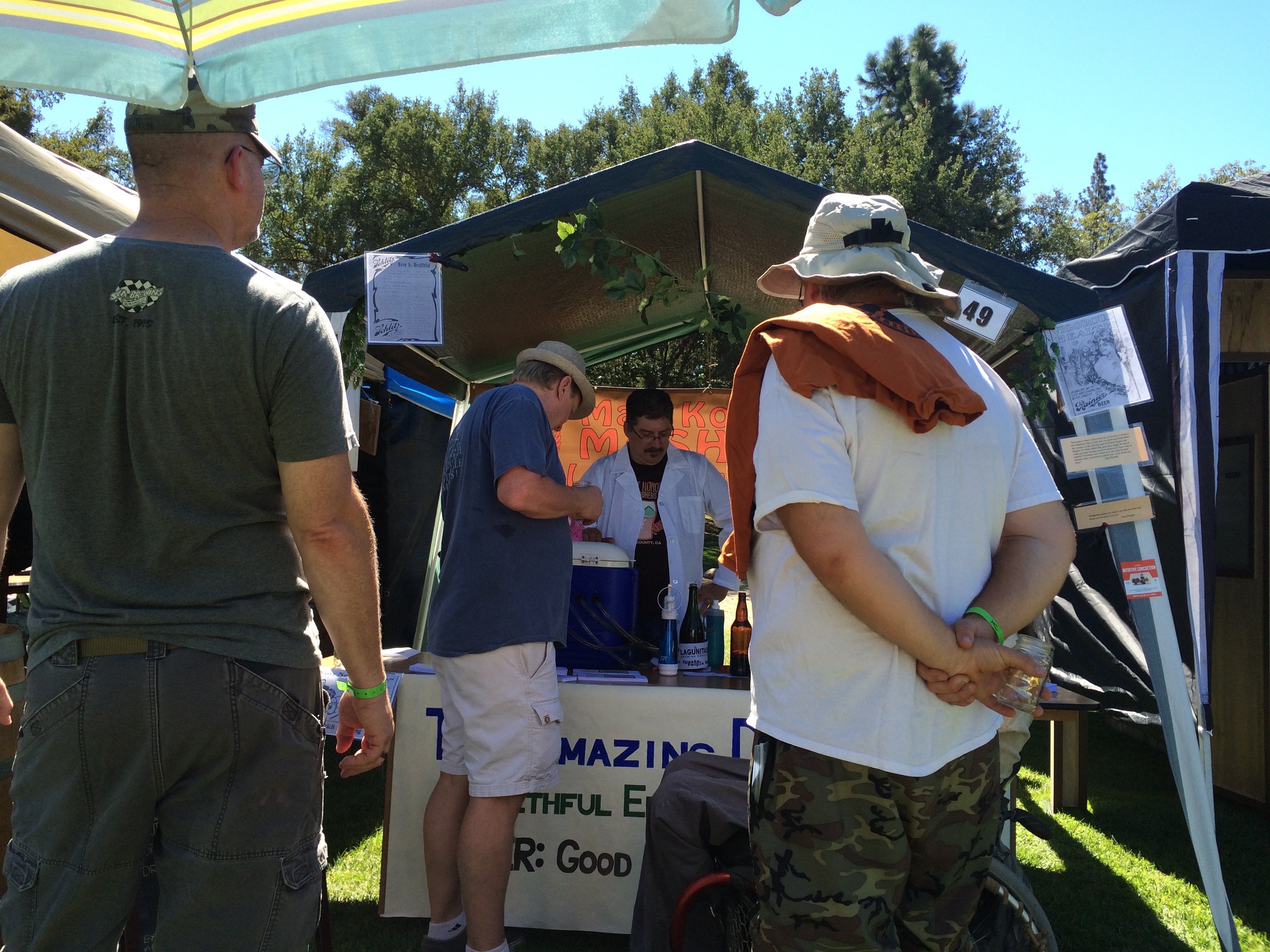
Dr. Paul tasting a prescription to see if it meets his exacting standards.
Patients could choose from a tasty array of medications.
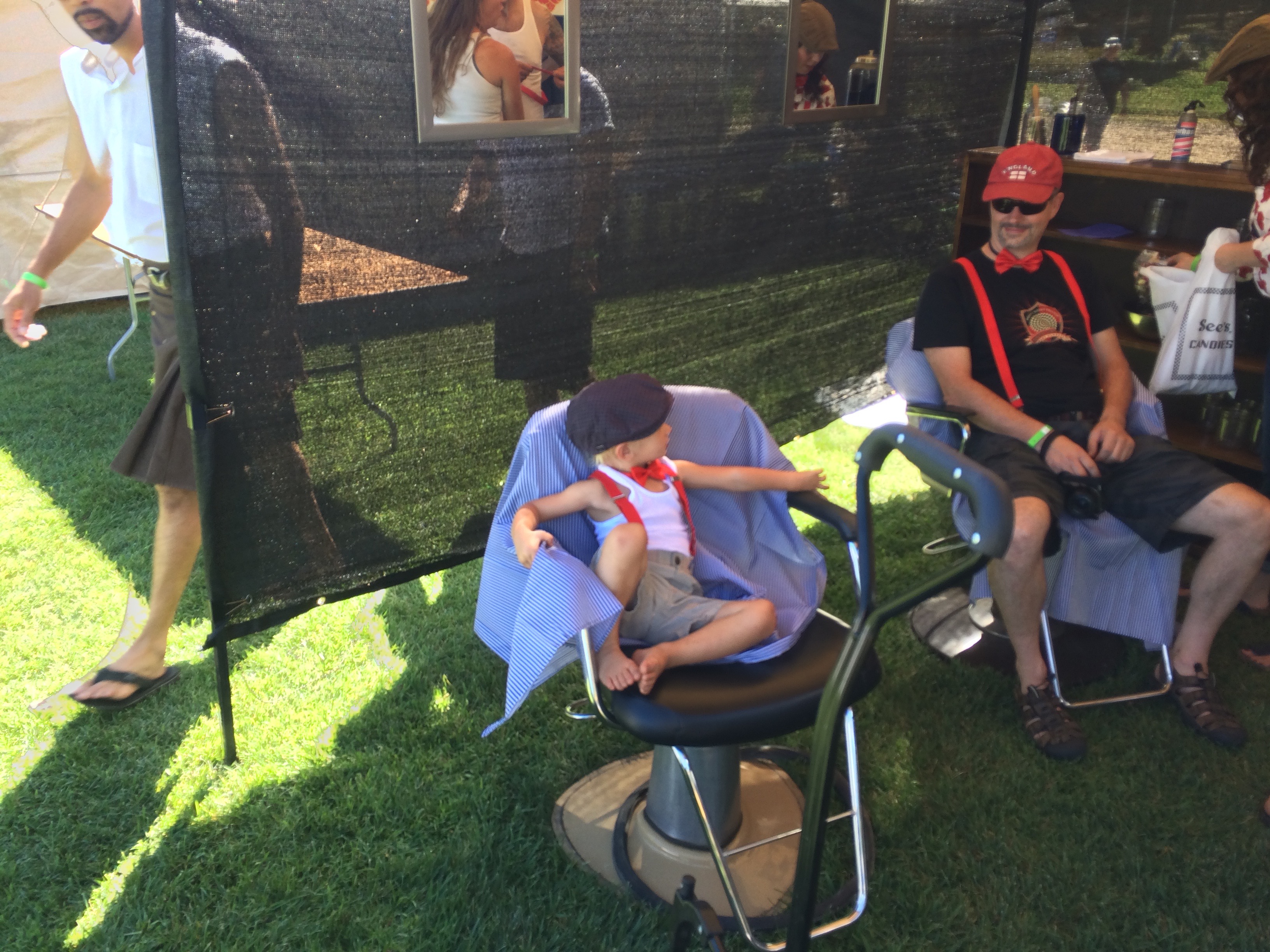
Next door to our booth was a “barber shop” where one of the aerosol cans of Barbasol dispensed an IPA.
The D.O.Z.E. ([Mt.] Diablo Order Of Zymiracle Enthusiasts) booth was a Dept of Treasury office with soda up front and samples of forbidden beer in the back.
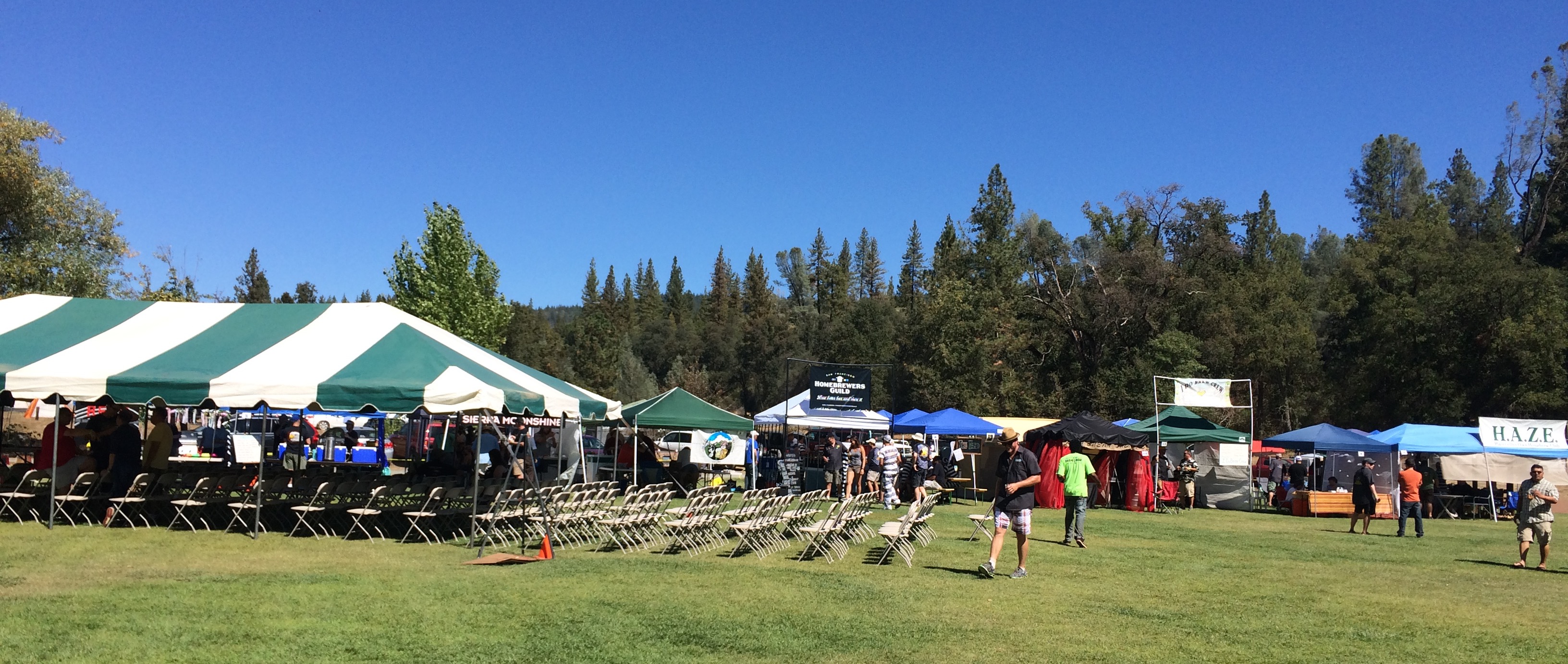
Looking to the left of our booth.
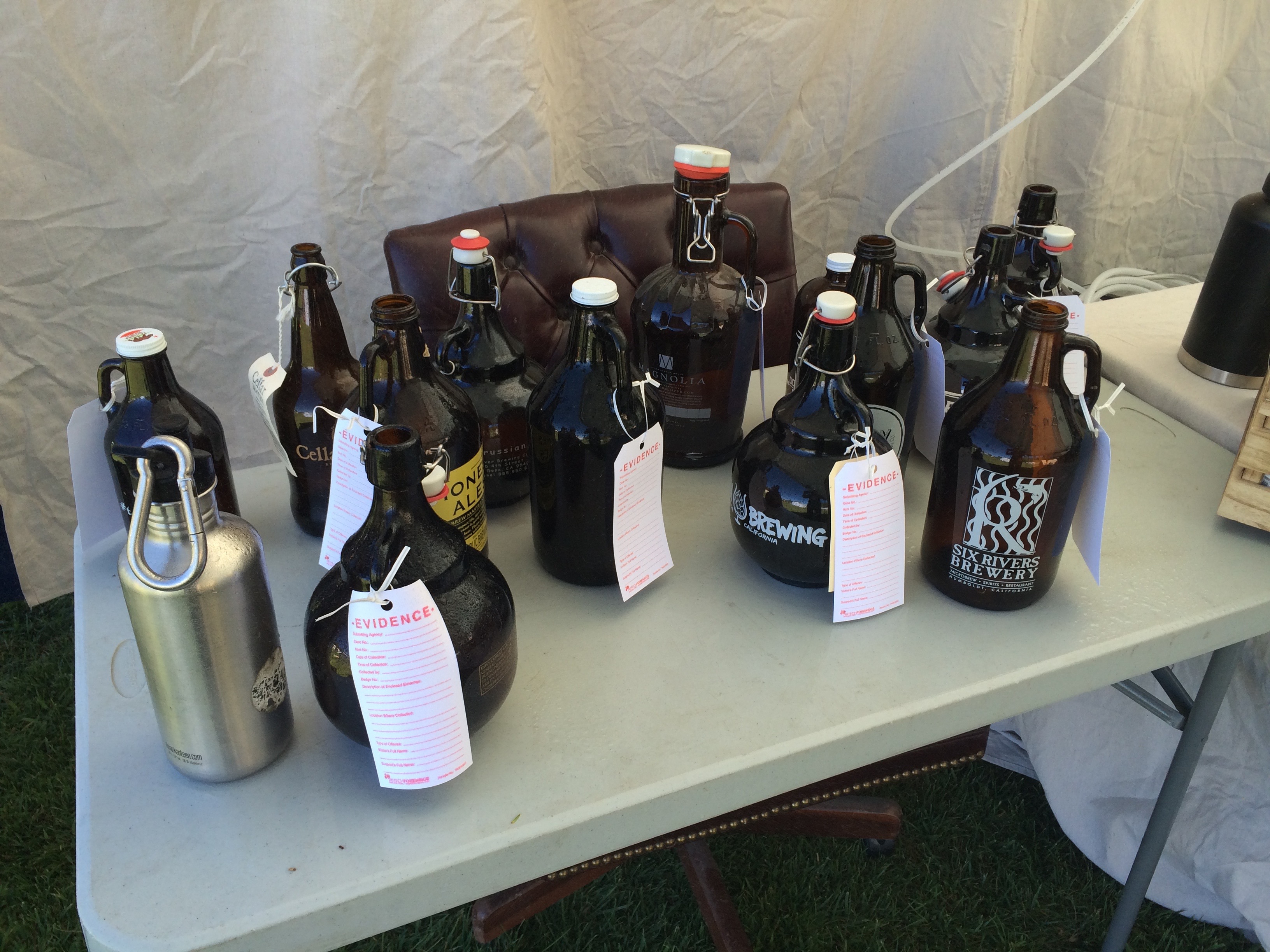
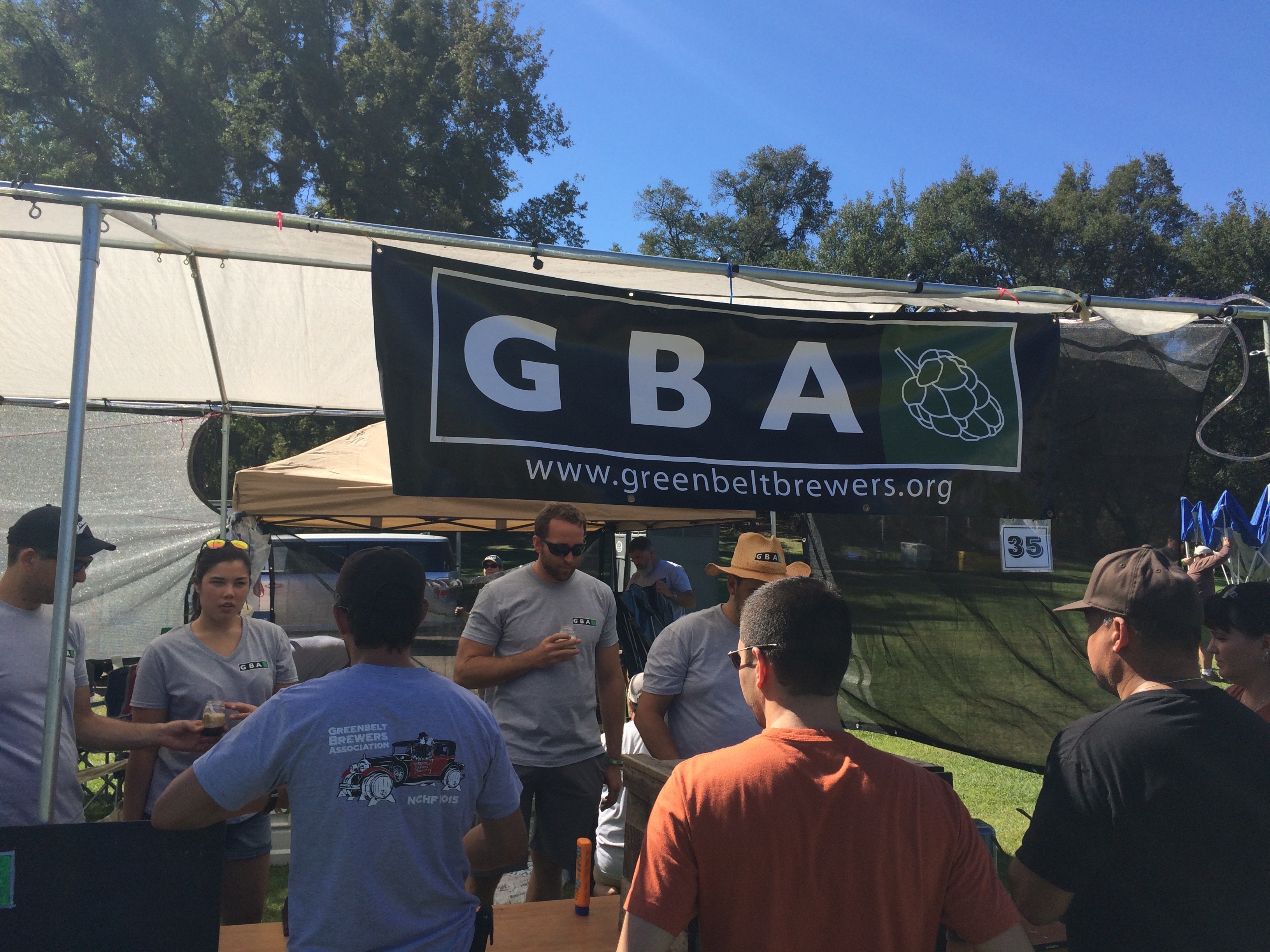
Evidence tags on illegal beer at the GBA booth.
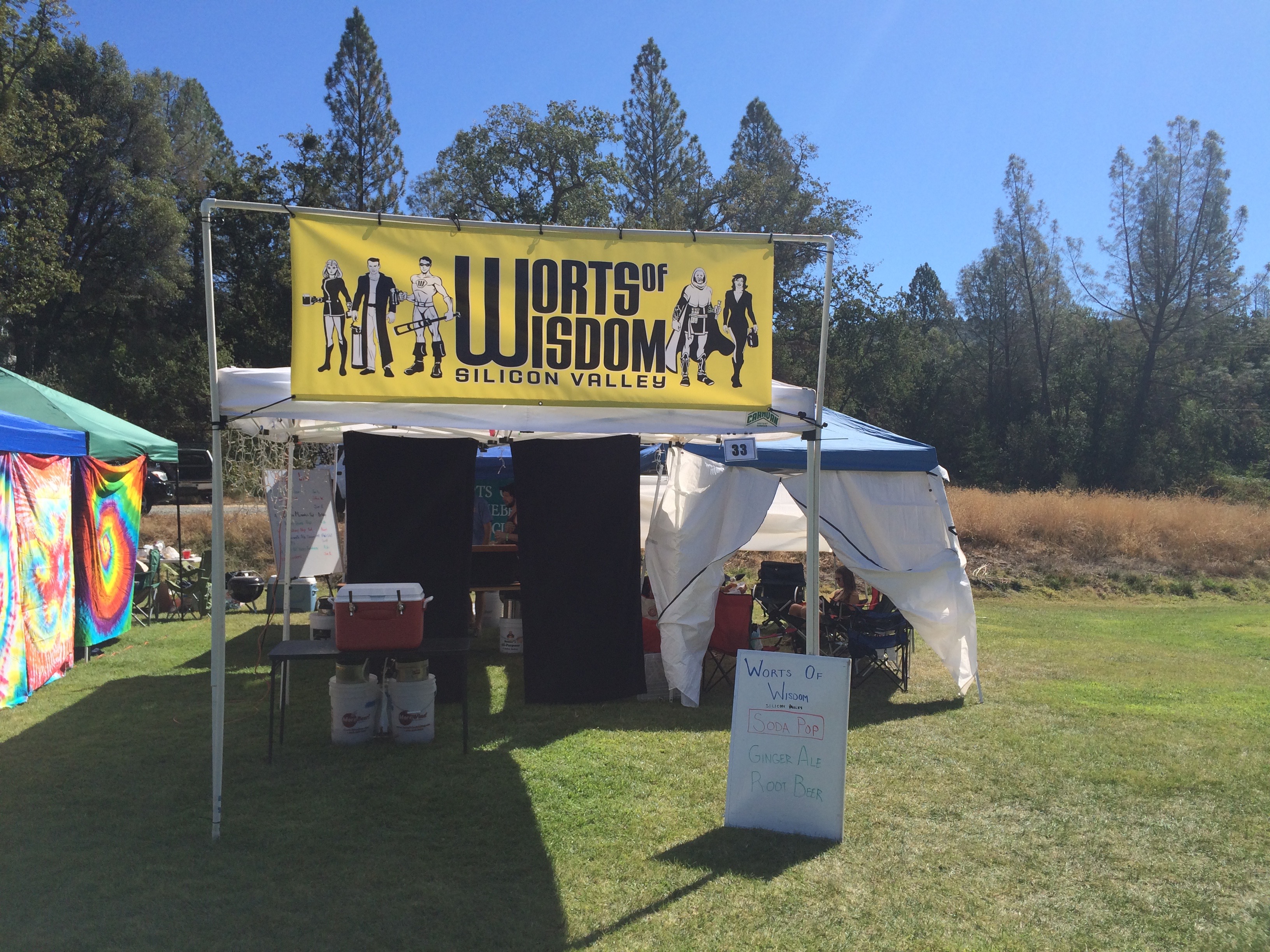
The Worts of Wisdom booth had soda in the front (self-serve). Word is that they had beer behind the curtain.
GBA’s serving list being prepared.
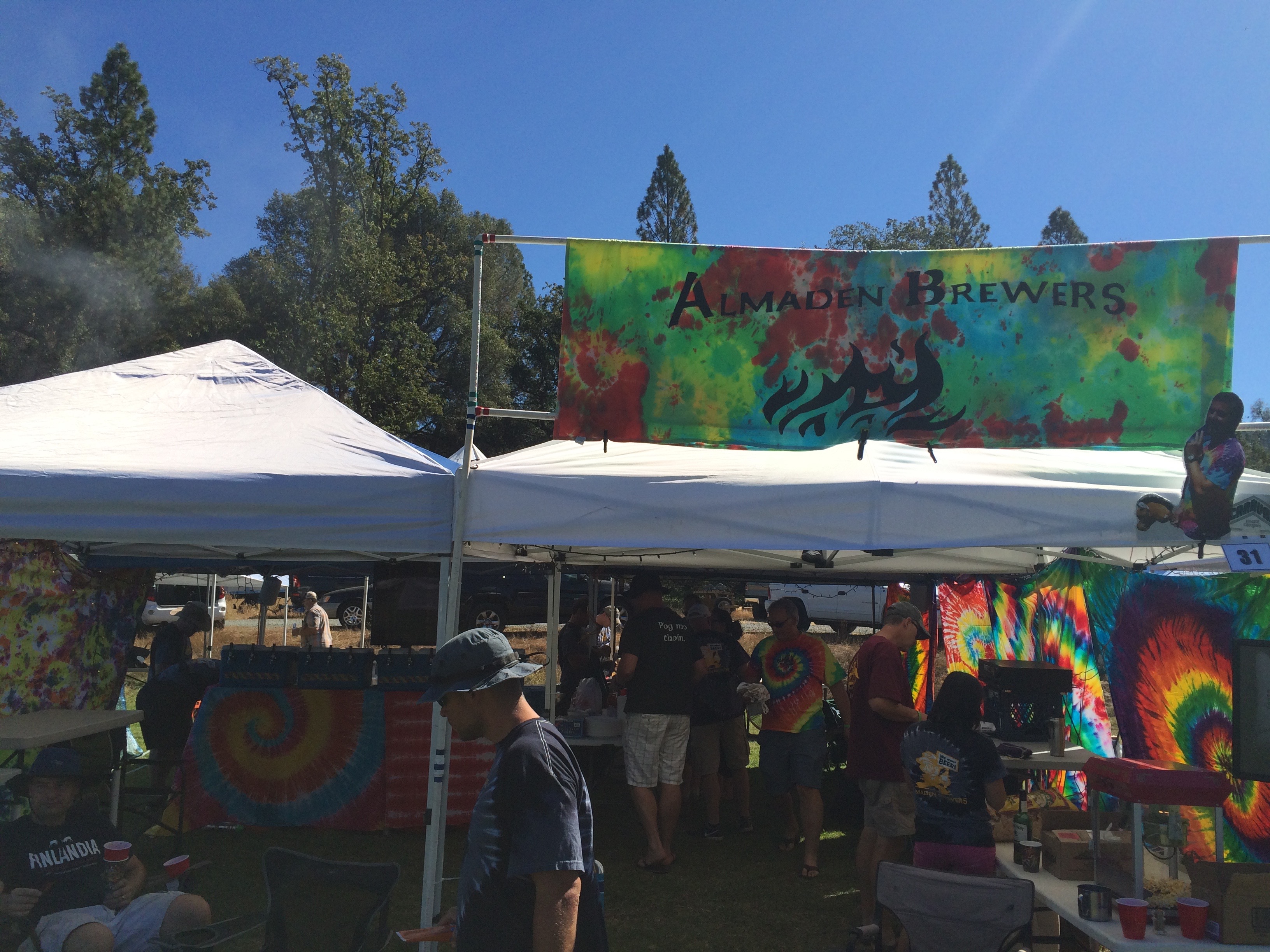
Almaden Brewers prove that tie-die is not dead, though it should be.
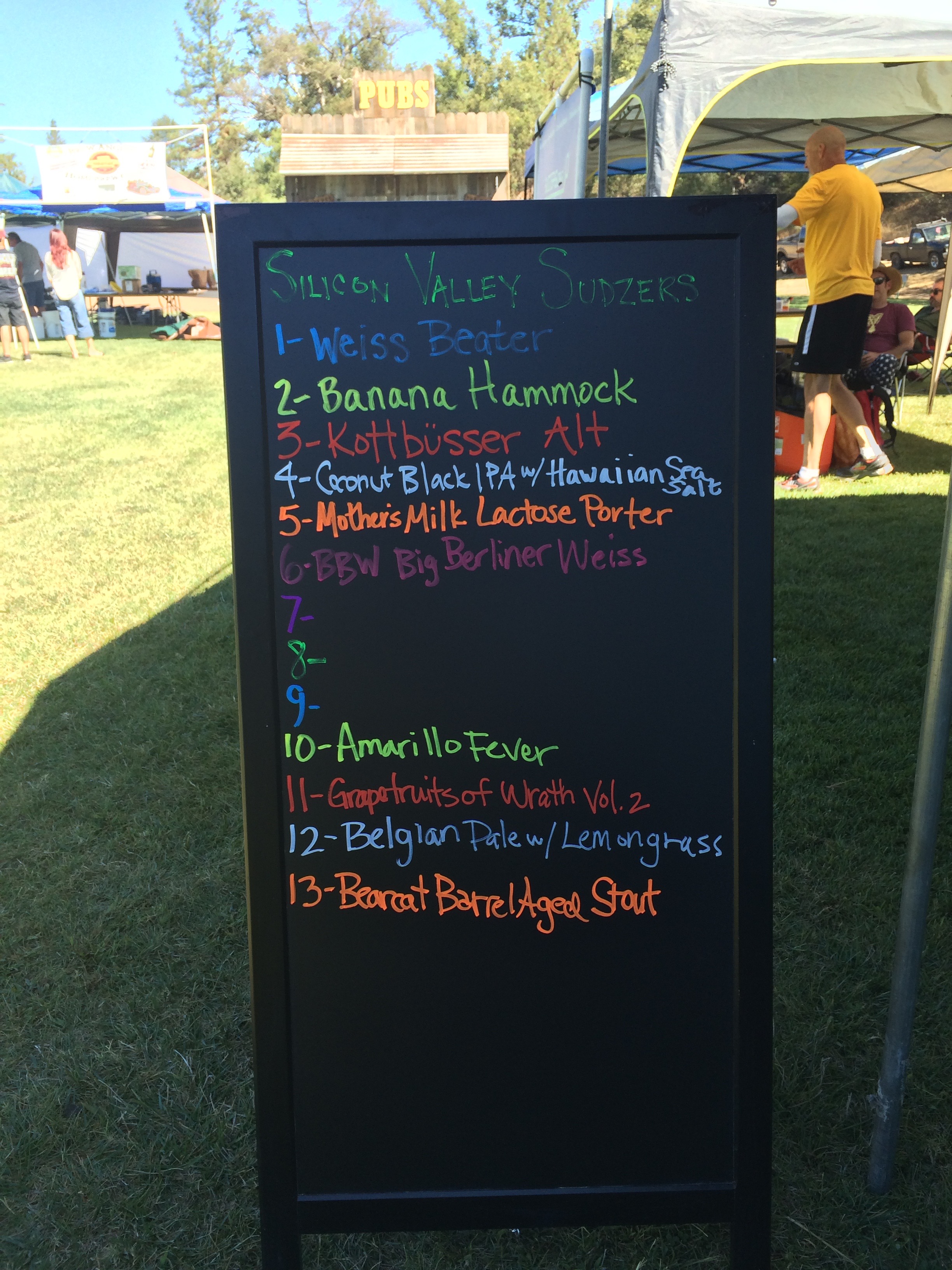
Silicon Valley Sudzers had some cute names for their beers.
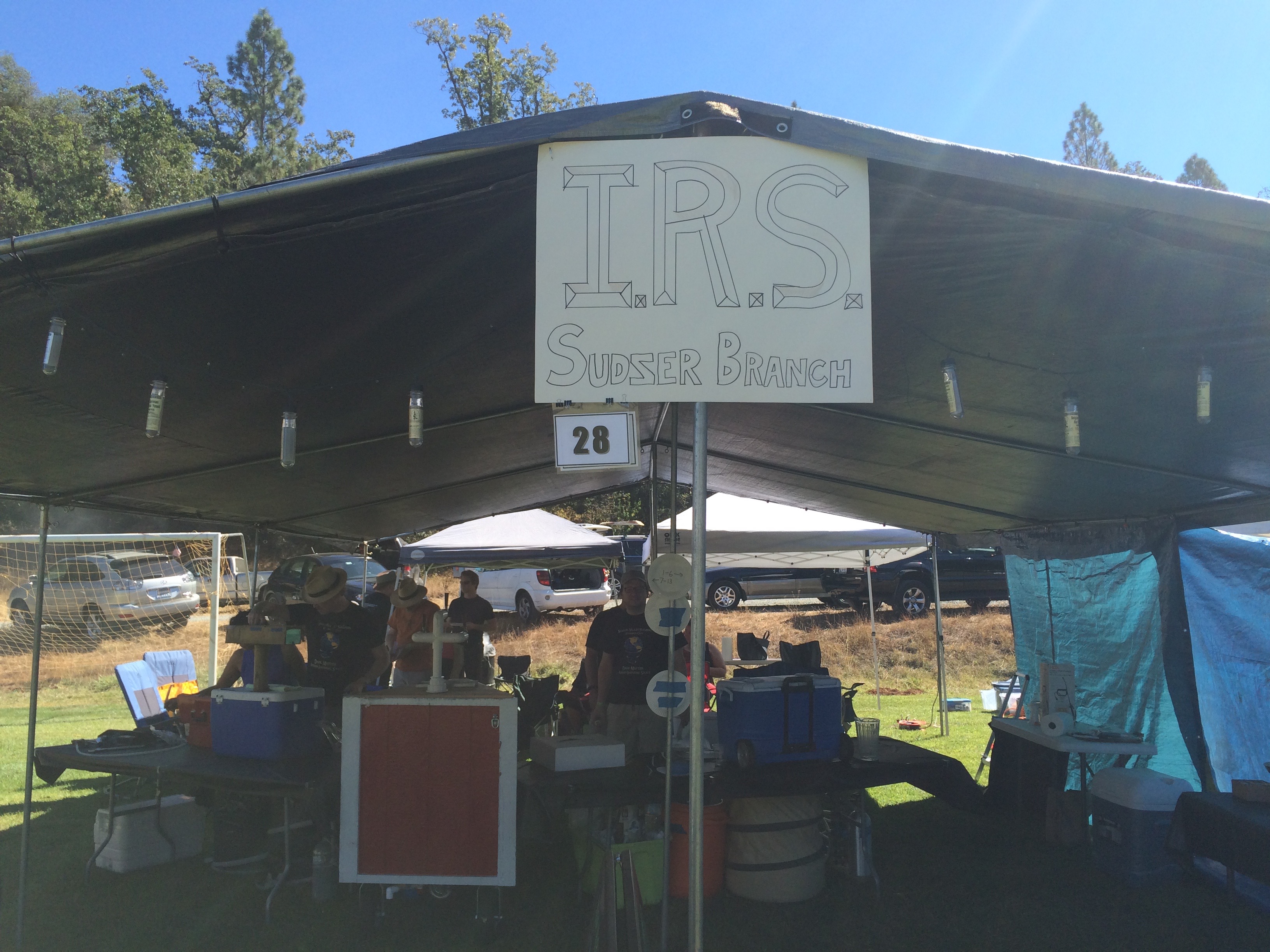
The Silicon Valley Sudzer branch office of the IRS.
The Doctor is in.
GBA getting rid of the evidence by drinking it away.
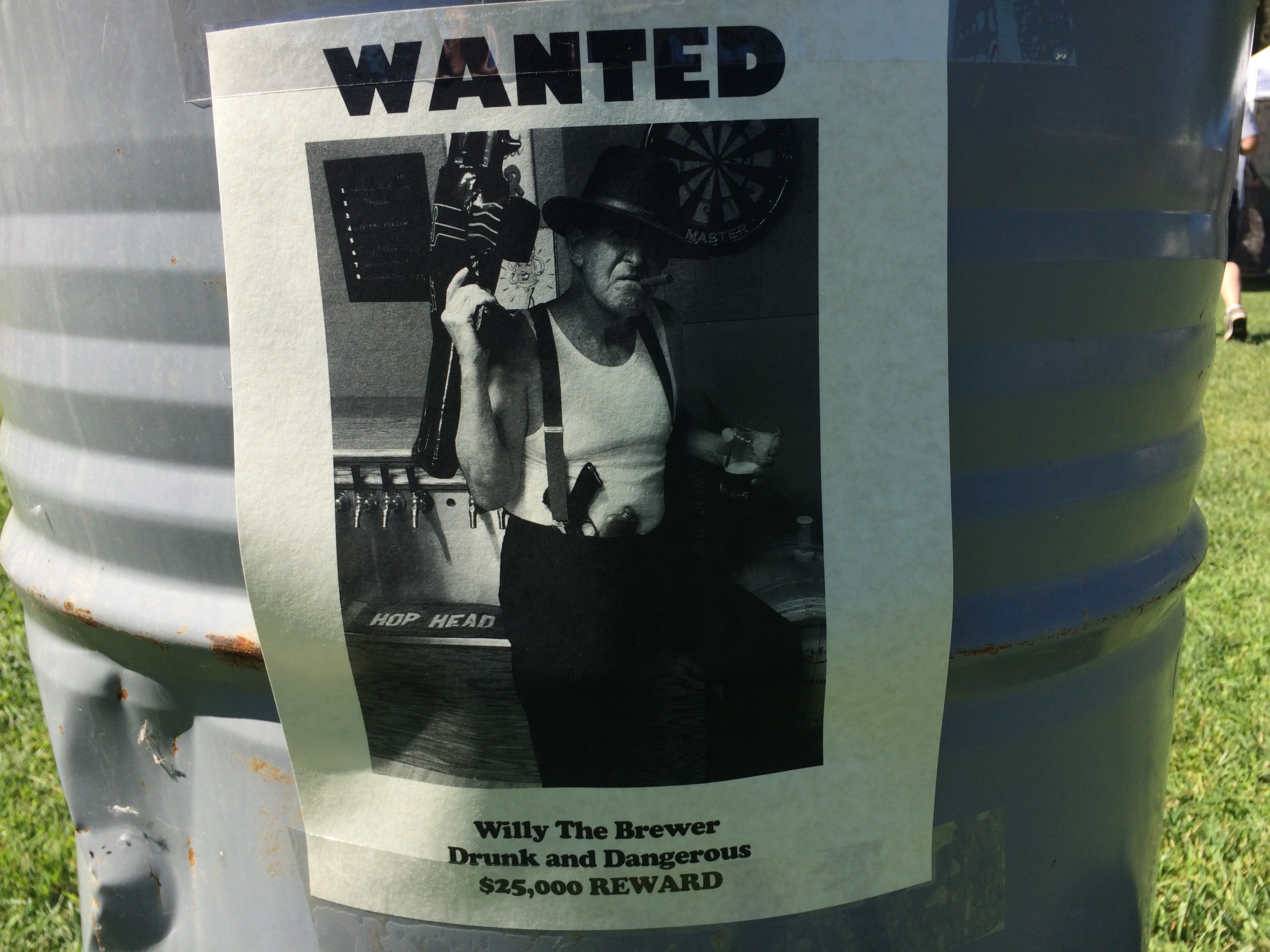
A wanted poster for Willie the Brewer on a trash can.
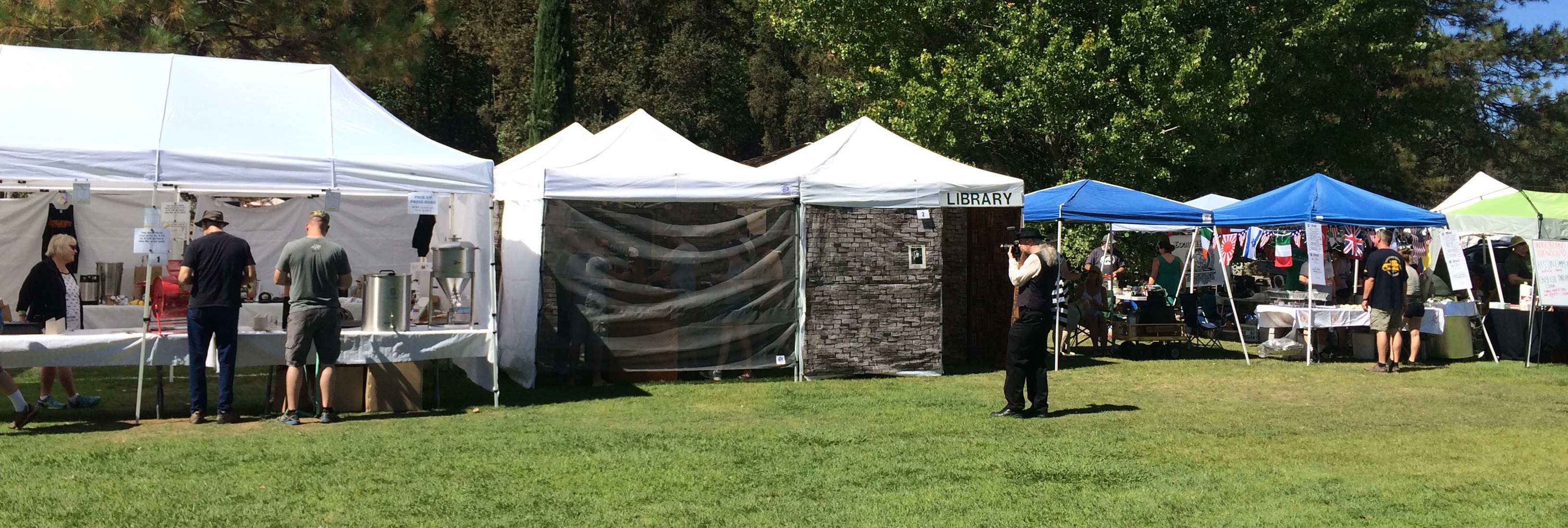
Across from our booth. The lecture tent and stage on the left.
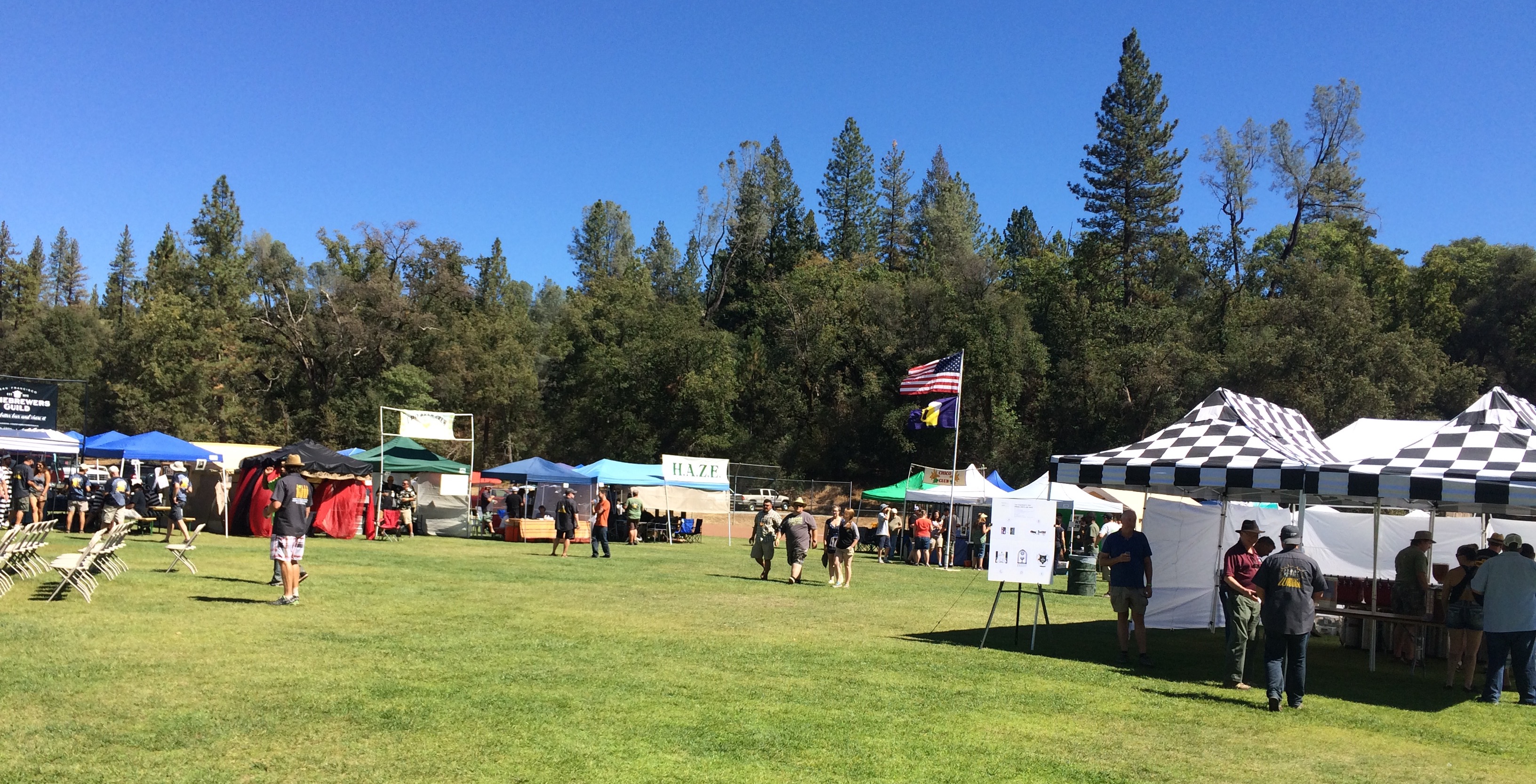
The checkered awning is the booth for tasting the club competition beers.
Lecture tent and stage on the right. More booths on the left.
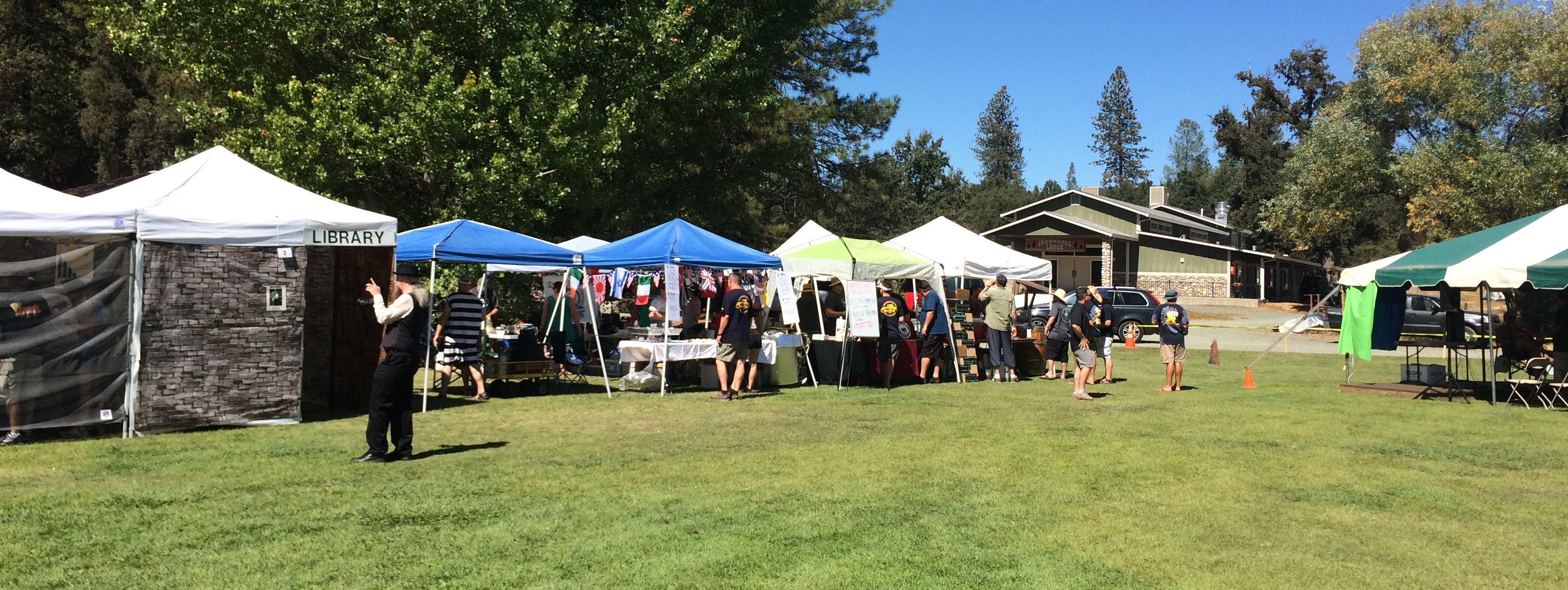
The “Library” with the faux stone walls had some amazing food.
Dr. Jon dispensing medicine to needy patients. The sign in front says, “The Amazing Dr. Paul’s Healthful Elixirs: Good for What Ales You.”
NCHF was bittersweet this year, landing as it did, during the Valley Fire. When we set up our booth, we knew at least one member had lost his home and two others were not sure. To say it put a damper on our spirits would not be overstating it.
We thought we might just have a pile of burnt rubble instead of any booth. In the end, we set up and made the best of it.
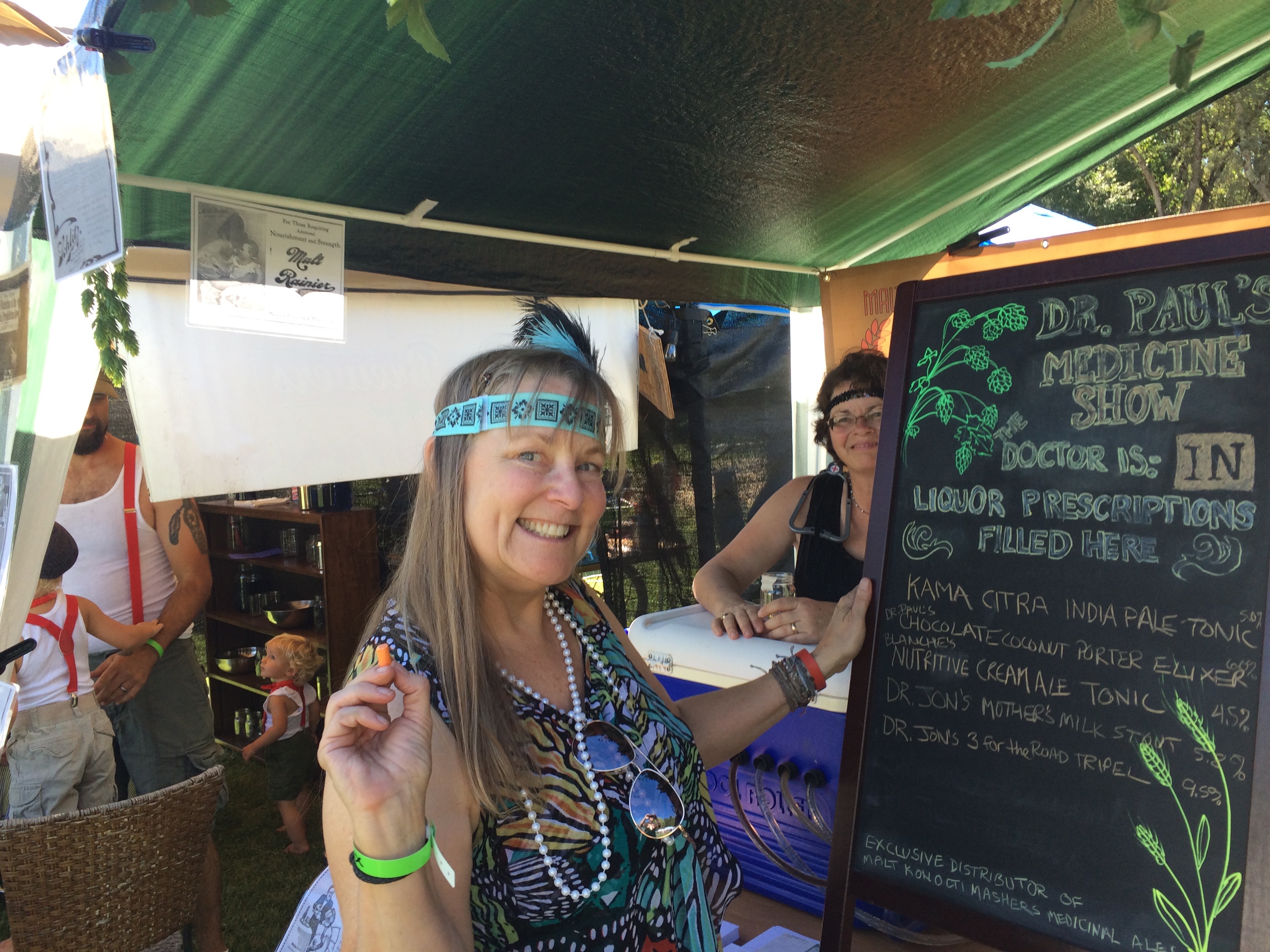
The theme this year was Prohibition. Prior to the event we did some research (okay we Googled it) and learned that prescriptions were written for alcohol. So we ordered some toy stethoscopes and reflective mirrors for our foreheads, and printed up some fake Rx pads. We prescribed many of the following: Dr. Kam A. Sutra’s India Pale Tonic, Dr. Paul’s Chocolate Coconut Porter Elixir, Blanche’s Nutritive Cream Ale Tonic, Dr. Jon’s Mother’s Milk Stout, or Dr. Jon’s Three for the Road Tripel.
Next year’s theme is…wait for it…Belgium. So if you like beer that tastes like a barnyard with cloves and bananas sprinkled about, you’ll love the NCHF in 2016.
I am currently listening to William Bostwick’s “The Brewer’s Tale: A History of the World According to Beer,” which, “is a beer-filled journey into the past: the story of brewers gone by and one brave writer’s quest to bring them—and their ancient, forgotten beers—back to life, one taste at a time. Pull up a bar stool and raise a glass to 5,000 years of fermented magic.”
Bostwick’s theme seems to be that beer continues to change and reinvent itself, and, as such, labels and categories confine it in a way that lessens its enjoyment by the drinker. Bostwick’s evocative language makes for a good story. I am saddened that the story is not quite as true as I would have hoped.
Why oh why am I still having to write lengthy corrections to articles about the history of India Pale Ale? Well, apparently because the Smithsonian magazine, the official journal published by the Smithsonian Institution, is happy to print articles about the history of India Pale Ale without anybody doing any kind of fact-checking – and William Bostwick, beer critic for the Wall Street Journal, appears to be one of those writers who misinterpret, make stuff up and actively get their facts wrong.
The article Bostwick had published on Smithsonian.com earlier this week, “How the India Pale Ale Got Its Name”, is one of the worst I have ever read on the subject, crammed with at least 25 errors of fact and interpretation. It’s an excellent early contender for the Papazian Cup. I suppose I need to give you a link, so here it is, and below the…
I check in on Twitter nearly daily. Here is a graphic that looked helpful to me and my fellow homebrewers. It’s a graphic, based on John Palmer’s Hop Wheel (found on page 30 in this PDF), and redesigned and updated by Tim Kreitz, that gives the primary characteristics of hops: spicy, citrusy, fruity, floral, piney (evergreen), herbal, earthy.
It has happened to all of us: the need to improvise, to use different ingredients than what was called for in the recipe or have the equipment or conditions be, shall we say, less than ideal. We might have had both of those conditions happen at the same time. That is when we brewers repeat Charlie Papazian’s mantra: “Relax, have a homebrew.”
When these less-than-optimal-conditions happen to me, I add, “At the end of the brew day, it will be beer.” These “Brewzasters” have happened at the professional level and produced some great beers; Lagunitas’s “Brown Shugga” was created when they added brown sugar to a batch of their Olde Gnarly Wine that was failing. These beers that come about from ‘making do’ may not fall into a class under the Beer Judge Certification Program guidelines but they can taste pretty darn good.
The beer that would become to be known as “steam beer” originated east of Sacramento on the American River in 1848. That is where and when John Marshall discovered gold. When the news leaked, immigrants flooded into California. Between 1848 and 1850, California’s population increased tenfold from around 8,000 (non-native) to nearly 90,000, and the hamlet of San Francisco swelled from 1,000 to 20,000.
The newcomers wanted beer. These Forty-Niners, needed something to slake their thirst. The water was not safe to drink. They wanted lager.
Lager beer was the new big thing, having been introduced by German immigrants to the east coast of the United States less than ten years earlier. However, the cost of shipping beer from the east coast to California was astronomical.
In those days shipping to San Francisco meant a 15,000-mile boat trip around the southern tip of South America. Or it meant an 8,000 mile journey to the Caribbean side of the Isthmus of Panama, going by canoe and then by mule through 80 miles of jungle to Panama City where steamships anchored infrequently, and reloading the cargo, and continuing on to San Francisco.
Obviously, brewers had to make the beer close by to be affordable, even by the inflated prices of stuff during the Gold Rush. However, California brewers had two problems: First, lager beers were fermented at 45–55 °F (7–13 °C), and second, they needed near-freezing temperatures to store (lager) the beer. California had neither of those.
On the east coast and midwest, breweries started by German immigrants located themselves near lakes that froze in the winter. That meant they had a ready supply of ice. In California, except for the Sierra Nevada in winter, there was nothing comparable. Plus, lagering took several weeks—too long and too expensive for impatient and thirsty miners.
When conventional does not work, it is time to get unconventional.
The brewers decided to try making lagers under warmer conditions. San Francisco has a cool climate, averaging in the high 50s during the winter to the low 70s during the summer. And for the brewers, that was close enough. They used cold-loving lager yeasts at temperatures that were more appropriate for brewing ales (60-68 °F or 16–20 °C) and a hybrid, “steam beer,” was born.
Improvising came with the job of brewer in the 19th century. According to one account, a starting brewer near Sacramento, made a mash tun “by joining wooden planks roughly together” and his boil kettle had “a tin bottom and a wood box on the top.”
Someone got the idea of putting the beer in shallow troughs, giving more surface area in order to cool the wort. Most contemporary sources say this was done while the wort was near boiling and well before the adding of the lager yeast. However, Wahl and Heinus’s American Handy Book of Malting and Brewing, published in 1902, say it was after the fermentation had begun—to clarify the beer rather than cool it. The beer would be “run into long, wide shallow vats called clarifiers, which are made of wood, about 12 inches high.”
Wahl and Heinus warned that brewers needed to take “precautions” to make sure that the clarifiers were not “too cold, so as to give the wort running out of the tubs a sudden setback which may check fermentation.” A brewer would not concern himself with a clarifier being too cold if the purpose was to cool the liquid, where “the cooler, the better,” would be the rule.
Wahl and Heinus warned that brewers needed to take “precautions” to make sure that the clarifiers were not “too cold, so as to give the wort running out of the tubs a sudden setback which may check fermentation.”
It is possible that these clarifiers did double-duty as coolers; Wahl and Heinus say that if no cooling apparatus was available, then “the wort is exposed overnight, or until it is cooled to about the above temperature.”
Steam beer tasted fruitier than lager due to esters being produced by fermenting at a slightly warmer temperature, but less so than ales. The warmer temperatures also meant the yeast finished fermentation faster, which was just fine with the brewers who were looking only to make something that tasted okay to the miners.
Make no mistake, the California brewers of the gold-rush era weren’t trying to be revolutionary; they were trying to meet a demand.
According to Wahl & Heinus, after a few days in the clarifiers, the brewers would ensure carbonation by adding “about five gallons” of Kräusen, rapidly fermenting beer from a recent batch, “per one general trade package called one-half barrel or 15 gallons.” This added rapidly fermenting beer would occupy “about 33 to 40 per cent” of the keg. To say this method ensured the beer would be carbonated understates the result. Wahl & Heinus reported pressure ranges from “40 to 70 pounds” per square inch “in each trade package.” Besides super- carbonating the cask, this method probably kept unwanted spoilers from ruining the beer.
The added rapidly fermenting beer would be “about 33 to 40 per cent” of the keg. To say this method ensured the beer would be carbonated understates the result. Wahl & Heinus reported pressure ranges from “40 to 70 pounds” per square inch “in each trade package.”
The brewers were not worried about handcrafting artisanal beverages; they were making beer—as fast as they could, “usually brewed and consumed within a month or three weeks.” Steam beer was also cheap and drunk by the “laboring classes,” people without a lot of money. ‘Good enough’ was good enough for them. As an 1893 Western Brewer magazine article waggishly put it, steam beer was “not a connoisseur’s drink.”
As an 1893 Western Brewer magazine article waggishly put it, steam beer was “not a connoisseur’s drink.”
No one knows why or how this unique beer style came to be known as steam beer. The stories do agree that many breweries sprouted in the west during the Gold Rush days (San Francisco had twenty-seven breweries in 1860) and they all made a beer called “steam beer.” It is possible that the beer, fermenting in the shallow open vats on rooftops, wafted clouds of steam in the cool morning air.
Perhaps steam beer was named after Dampfbier (literally: steam beer) brewed for centuries in southeastern Bavaria near the Czech border, and called steam beer because it produced “steam” during fermentation.
Perhaps it was called steam beer because it acted like steam. In 1849, to say something was steam powered meant it was fast and good. Steam meant new and exciting in those days; similar to the way “atomic” was used in the 1950s. “Steam” brimmed with revolutionary changes. Steam powered locomotives were faster than anything else around. Steam meant fast, hip, cool, new, and exciting—no boundaries existed for steam.
While I like the last possibility and think it had much to do with the beer’s name being used across the west coast of the United States, Wahl and Heinus say it was due to the “high effervescent properties and the amount of pressure (‘steam’) it has in the packages.” A cask would vent “steam,” as though it was a locomotive, when tapped.
The term Steam Beer dates back to the Gold Rush, the Anchor Brewing Company trademarked the term in 1981, after all, they were the only brewer left producing a product they called “Anchor Steam Beer.” Beer historian, Martin Lodahl wrote of this event, “[It] could be argued that the term [steam beer] has passed out of the general usage and into the specific, and further, that anyone else using the term for a commercial product could expect to benefit by Anchor’s prior use of the name.” That is if you made a steam beer, you were getting a boost from Anchor Brewing’s hard work, besides, Anchor had really changed the recipe over the years.
After Anchor trademarked a term that had been around for 130 years to describe a distinctly west coast-style beer, a new name was needed. Contemporary brewers have selected “California Common” to describe a beer that uses lager yeast fermenting at ale temperatures.
Anyone who has sampled a California Common beer would agree it is anything but common. It is unique. How about Atomic Beer?
If you want to be authentic and brew to style, Wahl and Heinus say your grain bill could be, “malt alone, malts and grits, or raw cereals of any kind, and sugars, especially glucose, employed in the kettle to the extent of 33 1⁄3%,” and “roasted malt or sugar coloring” added “to give the favorite amber color of Munich beer.” Mashing temperatures should be, “as a rule…taken about 140° to 145°F. Then to 149° to 154°F., mashed 10 to 15 min., and then raised to 158°F. as final temperature….The mash is allowed to rest about 45 min., and the same precautions taken in running off wort and sparging as in other mashes, the sparging water to be about 167°F.” Target gravities ranged from 11 to 12 1⁄2 percent Plato (1.044-1.050). Add “three-fourths of a pound” of hops per barrel (about two ounces for a five gallon batch) “in the usual way.” After a one-hour to two-hour boil, the wort should be cooled quickly to 60° to 62°F. It is up to you whether to use a clarifier and leave the wort exposed overnight.
As for carbonation, for safety’s sake, stick with three or four ounces of corn sugar per five gallons or one cup of malt extract. Stay away from adding 30-40 percent Kräusen to bottles—the bottles could easily explode to cause serious injury or death.
If Wahl & Heinus’s recipe is too general, Horst Dornbusch provided some good ones in December 2004 Brew Your Own. I like that he recommends Cluster hops rather than Northern Brewer. Cluster hops were grown extensively in the U.S. until just after 1910. He also recommends using malt extract or wort for priming, in keeping with the German brewers who started the style.
Recipes
California Common (5 gallons/19 L, all-grain)
OG = 1.052
FG=1.012
IBU = 35
SRM = 16
ABV = 5.2%
Ingredients
8.5 lbs. (3.8 kg) American 2-row pale ale malt (approx. 2.5 °L) 1.3 lb. (0.58 kg) Munich malt (10-20 °L)
1.0 lb. (0.45 kg) crystal malt (60 °L)
1.6 oz. (45 g) Cluster hops 6% alpha acid 9.5 AAU (bittering) 1.0 oz. (28 g) Cluster hops (aroma)
1 tsp. Irish moss
Wyeast 2112 (California Lager) or White Labs WLP0810 (San Francisco Lager) yeast
1 cup dry malt extract (for priming)
Step by Step
Start your mash at 130 °F (54 °C) for a 30-minute rest and increase the mash temperature, using a combination of hot-water infusion and direct heat, to 152 °F (67 °C) for a 60-minute saccharification rest, then to 168 °F (76 °C) for the mash-out. Recirculate your wort until it runs clear (about 15 minutes) and sparge with 170 °F (77 °C) water until you reach a kettle gravity of about 1.047 (11.8 °P) to account for evaporation losses during the boil. Boil for 75 minutes. Add the bittering hops after 15 minutes and the aroma hops and Irish moss after 70 minutes. After shutdown, let the brew rest for about 15 minutes. Pitch yeast at between 58 °F (14 °C) and 72 °F (22 °C).
Ferment for 10 days and rack. Allow an additional week for secondary fermentation. Rack again and prime for packaging. Let the brew condition in bottles or in a keg for another two to three weeks.
California Common (5 gallons/19 L, extract with grains)
OG = 1.052
FG = 1.012
IBU = 35
SRM = 16
ABV = 5.2%
Ingredients
6.25 lbs. (2.8 kg) pale ale liquid malt extract
1.3 lb. (0.58 kg) Munich malt (10-20 °L)
0.8 lb. (0.28 kg) crystal malt (60 °L)
1.6 oz. (45 g) Cluster hops 6% alpha acid 9.5 AAU (bittering) 1.0 oz. (28 g) Cluster hops (aroma)
1 tsp. Irish moss
Wyeast 2112 (California Lager) or White Labs WLP0810 (San Francisco Lager) yeast 1 cup dry malt extract (for priming)
Step by Step
Coarsely mill the 2.1 lbs. of specialty grains and place them into a muslin bag. Immerse the bag in cold water and heat slowly, for about 30 minutes to 170–190 °F (77–88 °C). Discard the bag without squeezing it and mix the liquid with about 4 gallons (15 L) of brewing liquor. Heat the liquor and stir in the liquid malt extract. Bring the dissolved malt extract to a boil. Boil for 75 minutes. Add the bittering hops after 15 minutes and the aroma hops and Irish moss after 70 minutes. After shutdown, let the brew rest for about 15 minutes. Pitch yeast at between 58 °F (14 °C) and 72 °F (22 °C).
Ferment for 10 days and rack. Allow an additional week for secondary fermentation. Rack again and prime for packaging. Let the brew condition in bottles or in a keg for another two to three weeks.
California Common (5 gallons/19 L, extract only)
OG = 1.052
FG = 1.012
IBU = 35
SRM = 16
ABV = 5.2%
Ingredients
6.25 lbs. (2.8 kg) pale ale liquid malt extract
1.66 lb. (0.75 kg) dark ale liquid malt extract
1.6 oz. (45 g) Cluster hops 6% alpha acid 9.5 AAU (bittering)
1.0 oz. (28 g) Cluster hops (aroma)
1 tsp. Irish moss
Wyeast 2112 (California Lager) or White Labs WLP0810 (San Francisco
Lager) yeast 1 cup dry malt extract (for priming)
Step by Step
Mix the malt extracts with your hot brewing liquor in the kettle. Bring the wort to a boil, and boil for 75 minutes. Add the bittering hops after 15 minutes and the aroma hops and Irish moss after 70 minutes. After shutdown, let the brew rest for about 15 minutes. Pitch yeast at between 58 °F (14 °C) and 72 °F (22 °C).
Ferment for 10 days and rack. Allow an additional week for secondary fermentation. Rack again and prime for packaging. Let the brew condition in bottles or in a keg for another two to three weeks.
Dornbusch, H. D. (2004, December). California Common: An American Brew for the Common Man. Retrieved January 28, 2013, from Brew Your Own: http://www.byo.com/stories/beer- styles/article/indices/11-beer-styles/416-california-common-style-profile
Harvard University Library Open Collections Program. (n.d.). California Gold Rush (1848– 1858). Retrieved October 5, 2012, from Immigration to the United States, 1789-1930: http://ocp.hul.harvard.edu/immigration/goldrush.html
Palmer, J. (n.d.). How to Brew by John Palmer. Retrieved October 8, 2012, from Chapter 10 – What is Different for Brewing Lager Beer?: http://www.howtobrew.com/section1/chapter10- 5.html
Smith, G. (1995). Beer: A History of Suds and Civilization From Mesopotamia to Microbreweries. New York, New York: Avon Books.
Wahl, R., & Heinus, M. (1902). American Handy Book of the Brewing, Malting and Auxiliary Trades: A Book of Ready Reference for Persons Connected with the Brewing, Malting and Auxiliary Trades, Together with Tables, Formulas, Calculations, Bibliography and Dictionary of Technical Terms. http://archive.org/details/americanhandybo00wahlgoog
I received an email from the contact Batch-22 link today that asked “Where can I get rhizomes?”
Rather than respond via email, it makes just as much sense to answer this online.
Zeus hop bines with flowers
Rhizomes, if you are not familiar, are root cuttings from female hop plants. Females produce the hop cones that brewers put in the boiling wort.
Entering “Hop rhizomes” into a web search yields a full page of companies that sell rhizomes. I get mine through MoreBeer. See: http://morebeer.com/category/hop-rhizomes.html Plenty of other homebrew supply stores sell hop rhizomes when they are available. MoreBeer is out of 2014’s stock and will send an email when you can preorder 2015’s varieties. Do some research and find the one that will grow in your climate.
Yesterday saw the brewing of another batch of the crowd pleasing Jago Bay Pale Ale, the house pale ale. Our sensory panel (well, me and some of the Malt Konocti Mashers, but “sensory panel” sounds better) says,
“This, to me, is a classic pale. In the Sierra Nevada Pale Ale template. There is an upfront sweetness/maltiness, a bready and toast flavor midway, followed by a the hop bitterness. A very drinkable beer.”
“WOW.”
This was the ninth iteration of the house pale. Each time the recipe has been tweaked by one item to learn if the change was better or not. The switching from Vienna to Victory malt has added a pleasant complexity, a bready flavor that is a keeper (though Amber malt will be tried soon–it has the same qualities with slightly more intensity).
Not yet fully carbonated. This house pale ale is a nice blend of malt, hoppiness, and toastiness.
If your first pick for an ice cream flavor is vanilla, you may be a Pale Ale person. That vanilla ice cream tells you a lot about the other flavors that the maker has and how good they will be. Pale Ale, like vanilla, is the base for everything else in the lineup.
Gordon Strong, the world’s only Grand Master Level V Beer Judge, says this about American Pale Ale:
I always call for an American pale ale first. Why? Well, it’s a common style that every pub should have, and it allows for some creativity. But it also takes a little bit of finesse and is a good measure of the brewer’s skill. The same holds true with homebrewers; don’t tell me about all the oddball beers you can make. Show me first that you have your basic skills down. Give me an everyday American pale ale.
Making a drinkable and yet interesting American Pale Ale continues to be my quest. This last batch seems to be the grail. Good hop flavor with a touch of sweetness from the Caramel 60 malt and toastiness from the Victory malt.
Usually a moderate to high hop flavor… Low to moderately high clean malt character supports the hop presentation, and may optionally show small amounts of specialty malt character (bready, toasty, biscuity)….Caramel flavors are usually restrained or absent. Fruity esters can be moderate to none. Moderate to high hop bitterness with a medium to dry finish. Hop flavor and bitterness often lingers into the finish. No diacetyl [burnt butter or butterscotch flavor].
This American Pale Ale recipe started out as the American Pale Ale recipe from “Brewing Classic Styles: 80 Winning Recipes Anyone Can Brew” by Jamil Zainasheffand JohnPalmer. It has been tweaked enough that it is now quite different. The latest tweak was to substitute Victory malt for the Vienna malt (which had replace Jamil’s Munich malt in the original recipe). The Sinamar in the recipe adds color without the flavor that would come from Chocolate malt or Midnight wheat.
This is a 10 gallon batch and the mash efficiency is at 82%. If your efficiency is higher or lower, you will need to adjust your amounts.
Est Original Gravity: 1.052 SG
Est Final Gravity: 1.011 SG
Estimated Alcohol by Vol: 5.3 %
Bitterness: 38.3 IBUs
Est Color: 8.2 SRM
Once a year at the time of the Autumnal Equinox, homebrewers from all over Northern California make the trek to the little town of Dobbins and call Lake Francis their home for two days. Here they proudly fly the colors of their homebrew clubs and eagerly share well-crafted homebrew, rivaling some of the best known craft breweries.
The theme this year was Go West Young brewer. Next year’s theme is Prohibition.








 Batch-22